Cosmic Expansion and Celestial Evolution
From the invisible filaments of dark matter to the violent birth of stars, modern astrophysics is refining our understanding of the universe's past and its accelerating expansion.
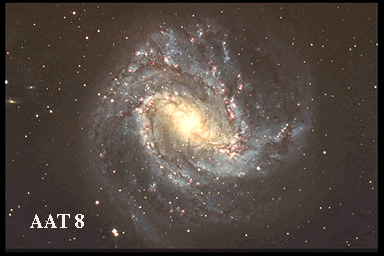
Shadows in the Cosmic Web
The architecture of the universe is defined by a tension between the visible and the invisible. While baryonic matter—the stuff of stars, planets, and observers—gathers into bright, concentrated clumps, it constitutes only a fraction of the total mass. The rest is dominated by dark matter, a pervasive, unseen substance that forms a complex, filamentary web across the cosmos. This structure provides the gravitational scaffolding necessary for galaxies to coalesce and rotate at the speeds we observe, acting as a silent anchor for the celestial dance.
Dark matter acts as the scaffold of the cosmos, yet it is now eclipsed in mystery by the repulsive force of dark energy.
The Persistence of General Relativity
For decades, the standard model of cosmology has relied on the framework of general relativity to describe the expansion of the universe. Recent, high-precision measurements from the Dark Energy Spectroscopic Instrument have tested this foundation with unprecedented rigor. By analyzing the clustering of galaxies and the light from the early universe, researchers have sought signs of modified gravity that might explain the accelerated expansion of space. To date, these results remain stubbornly consistent with Einstein’s original equations, suggesting that if the universe is behaving in unexpected ways, the cause likely lies in the nature of the energy driving that expansion rather than a breakdown of gravity itself.
Standardizing the Transient
To map the history of the cosmos, astronomers require standardizable candles—objects with predictable intrinsic brightness that serve as distance markers. While Type Ia supernovae have long held this role, gamma-ray bursts offer a way to probe the universe at much greater distances, reaching back to epochs when the first galaxies were still forming. By calibrating the fundamental relations between their peak luminosity and the duration of their emission, researchers are now able to use these violent events to extend the cosmic distance ladder. These bursts not only reveal the geometry of space but also provide a window into the chemical enrichment of the early universe, showing that even in the first few billion years, star formation proceeded at a rate sufficient to produce heavy elements in abundance.
Gamma-ray bursts serve as beacons from the deep past, allowing us to measure the expansion of the universe across vast reaches of time.
The Evolution of Protostellar Nurseries
The formation of stars is a process of collapse and feedback, where dense clouds of gas and dust are sculpted by gravity, magnetic fields, and radiation. Observations of infrared dark clouds and low-mass protostars reveal a complex environment where quiescent material coexists with turbulent, shock-driven gas. Modern simulations show that the formation of protoplanetary discs is a resilient process, occurring even under varying magnetic conditions. As protostars emerge, they release jets that regulate their own growth and influence the surrounding environment, ensuring that the birth of a stellar system is as much about the dispersal of material as it is about its accumulation.
Stability and Change in the Stellar Atmosphere
Even the most massive and evolved stars are subject to the same physical laws that govern the smallest particles. Observations of red supergiants like Betelgeuse reveal an inner atmosphere that is far from static, characterized by persistent convective patches and temperature irregularities that defy simple models. These structures, while stable over years, are constantly reshaped by underlying shocks. Similarly, the internal structure of neutron stars—the remnants of stellar death—exhibits a remarkable universality. Despite the extreme densities involved, their observable properties, such as tidal deformability, follow predictable relations that depend only on a few fundamental parameters. This suggests that even in the most extreme conditions, the universe maintains a degree of order that allows us to infer the nature of the deep interior from the surface alone.