Spacetime Vibrations and Cosmic Observatories
Beyond the initial detection of black hole mergers, a new generation of observatories is beginning to map the subtle, complex vibrations of the universe.
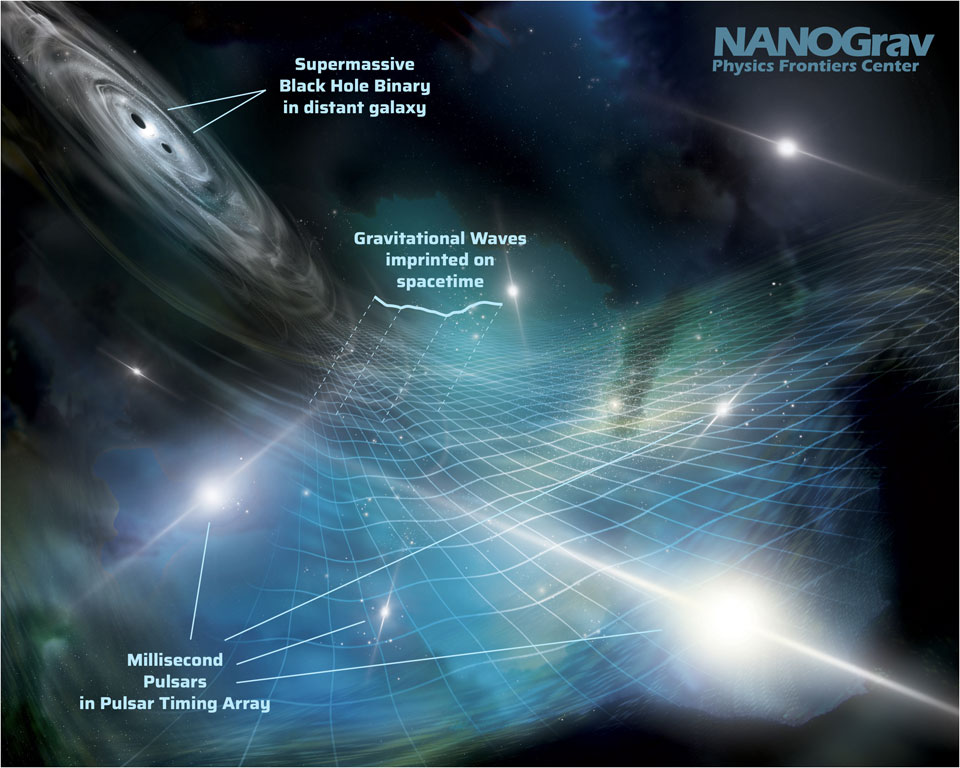
Listening to the Background Hum
For decades, our understanding of the cosmos relied on the light that reached our telescopes. This changed when we began to detect the subtle, rhythmic warping of spacetime caused by massive objects in motion. While the LIGO and Virgo observatories have successfully captured the high-frequency chirps of individual black hole mergers, a more pervasive phenomenon exists: a low-frequency gravitational wave background. This hum, likely produced by the collective influence of millions of supermassive black hole binaries, was recently identified by monitoring the precise timing of pulsars across the galaxy. By observing the correlated shifts in pulse arrival times, researchers have confirmed that the universe is constantly vibrating with the echoes of ancient, colossal events.
The universe is not merely seen; it is heard in the rhythmic distortion of space itself.
The Challenge of Precision
Translating these fleeting signals into physical knowledge requires an extraordinary degree of mathematical fidelity. When a binary system spirals toward collision, the resulting waveform encodes the masses, spins, and orbital characteristics of the participants. However, extracting these parameters is hindered by degeneracies—situations where different physical configurations produce nearly identical signals. For instance, in the case of supermassive black hole binaries, certain spin-inversion motions are so closely mirrored by non-inverting systems that current models struggle to distinguish them. As detectors become more sensitive, the need for models that can account for these complex, multi-harmonic dynamics becomes paramount.
Furthermore, the computational cost of simulating these systems is immense. Tracking millions of orbits for extreme mass-ratio inspirals—where a small object orbits a massive black hole—requires tracking harmonic modes over vast timescales. Researchers are now turning to machine learning and advanced operator theory to generate surrogate waveforms that are both rapid and accurate. By treating the waveform as an observable and utilizing the Koopman operator, physicists can navigate orbital resonances without the mathematical singularities that previously plagued their calculations.
Lensing and the Geometry of Shadows
Gravitational waves do not travel through a vacuum of influence; they are subject to lensing by intervening matter, much like light. In the geometric optics regime, where the wavelength is small compared to the lens, certain degeneracies can obscure the true nature of the source. However, gravitational waves occupy a unique position because their wavelengths are often comparable to the size of the lenses themselves. This transition into the wave-optics limit allows us to break the mass-sheet degeneracy that often plagues electromagnetic observations.
While current ground-based detectors face limitations in resolving these effects, the next generation of observatories will possess the sensitivity required to treat lensing as a diagnostic tool. By disentangling the effects of the lens from the source, astronomers expect to gain a clearer view of cosmological parameters and the distribution of matter throughout the history of the universe.
Every ripple in spacetime acts as a lens, bending the history of the light that preceded it.
The Next Generation of Observation
The future of the field rests on a global network of third-generation observatories, including the proposed Cosmic Explorer and the Einstein Telescope. These instruments will be orders of magnitude more sensitive than their predecessors, enabling the detection of events occurring shortly after the Big Bang. By operating in concert, these detectors will provide the localization precision necessary for multimessenger astronomy—the practice of observing both gravitational waves and electromagnetic counterparts, such as kilonovae.
This synergy is already yielding results. New probabilistic frameworks are being developed to predict kilonova spectra directly from the gravitational wave data of neutron star mergers. By marginalizing over uncertain variables, these models allow researchers to interpret observations with greater confidence. As we move toward a network capable of detecting primordial black hole mergers and continuous waves from rotating neutron stars, the focus remains on refining our ability to interpret the complex, eccentric, and asymmetric signals that define the deep-space landscape.