Mapping the Invisible
From the debris of our own solar system to the distant mechanics of star formation, the practice of astronomy has evolved into a precise, data-driven discipline.
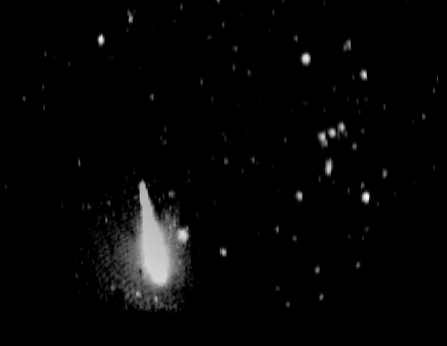
The Ledger of Debris
The night sky has long served as a mirror for human anxiety and curiosity. Ancient observers looked up to find omens of falling empires in the tails of comets, while modern science treats the same celestial phenomena as data points in a vast, ongoing inventory. We now understand that the space surrounding our planet is not empty, but a busy thoroughfare of debris. From the microscopic dust that settles daily to the rare, brilliant fireballs that outshine the stars, Earth exists in a state of constant, low-level bombardment. This reality has shifted our gaze from the superstitious to the systematic, as we map the paths of asteroids and the cycles of lunar craters to better understand the history of our own neighborhood.
The sky is not a static backdrop but a ledger of collisions, heat, and light waiting to be read.
Refining the Distant Signal
Beyond our solar system, the work of classification continues with increasing precision. Astronomers now look to the wobbles of distant stars and the dips in their brightness to identify planets that were once entirely theoretical. The discovery of systems like GJ 414 A, with its distinct planetary companions, demonstrates how far our reach has extended. Yet, this progress requires more than just better glass; it demands sophisticated mathematical frameworks. By refining the spectral templates used to analyze young stars, researchers can now untangle the complex signals of accretion and stellar mass, moving past the limitations of older, less nuanced models to see the mechanics of star formation with greater clarity.
The Physics of Prediction
The effort to understand the universe is matched by the need to monitor the environment closer to home. Modern space weather forecasting relies on complex magnetohydrodynamic models that simulate the solar wind from the sun to Earth, providing a vital shield for our technological infrastructure. Simultaneously, researchers are employing hybrid algorithms that combine radiative transfer with machine learning to interpret satellite data. By training models on simulated datasets and fine-tuning them with real-world observations, scientists can now retrieve aerosol properties with a level of accuracy that was previously unattainable, allowing us to track pollution events and atmospheric changes in real time.
We are building a digital mirror of the heavens, one that accounts for the volatile physics of the sun and the subtle shifts in our own atmosphere.
The Institutional Reach
The institutional backbone of this progress is built by individuals who bridge the gap between raw observation and policy. Astronomers like Martha P. Haynes have spent decades not only mapping the distribution of galaxies but also guiding the scientific community through the rigorous processes of decadal review and international cooperation. Her career, marked by the development of major survey projects and leadership in global astronomical organizations, highlights the collaborative nature of modern science. It is a field that requires both the individual capacity to interpret the faint light of distant structures and the collective discipline to maintain the instruments and organizations that make such discovery possible.