Remnants of a Crowded Workshop
From the sulfur-rich magmas of Mercury to the iron-laden winds of distant gas giants, the history of the solar system is written in chemistry, collision, and dust.
The Volatile Archive
Planetary science often presents itself as a study of static, distant objects, yet the field is increasingly defined by the volatile, messy interactions that govern the life and death of celestial bodies. From the microscopic chemistry of a magma chamber on Mercury to the violent consumption of planets by their host stars, the history of our solar system and others is a record of constant transformation. We are learning that planets are not merely inert spheres, but active participants in a chaotic cosmic environment where chemical signatures and physical debris tell stories of ancient collisions, internal heat, and atmospheric escape.
Planets are not merely inert spheres, but active participants in a chaotic cosmic environment.
Sulfur and the Mercurian Interior
On Mercury, the extreme conditions of the planet's interior dictate a unique geochemical path. Research into the sulfur-rich lavas of the innermost planet reveals that its low oxygen environment forces sulfur to bond with metals like magnesium and calcium rather than iron. This specific speciation alters the very viscosity and melting points of the planet's mantle, creating a distinct evolutionary trajectory compared to Earth. These chemical choices at depth eventually manifest on the surface, influencing the mineral stability of the crust and demonstrating how the invisible fugacity of a planet's interior shapes its observable geology.
Iron in the Clouds
Beyond our own neighborhood, the atmospheres of ultra-hot gas giants provide a window into extreme dynamics. Observations of WASP-76 b have identified blueshifted emission lines of neutral iron, suggesting that material is being lofted from the planet's hot spot into the upper atmosphere. This thermal inversion layer, confirmed by spectroscopic analysis, highlights the violent energy transport occurring within these worlds. Such findings move us past simple characterization, allowing for a more nuanced understanding of how heat and chemistry circulate in environments that defy terrestrial intuition.
Fragments of a Formative Era
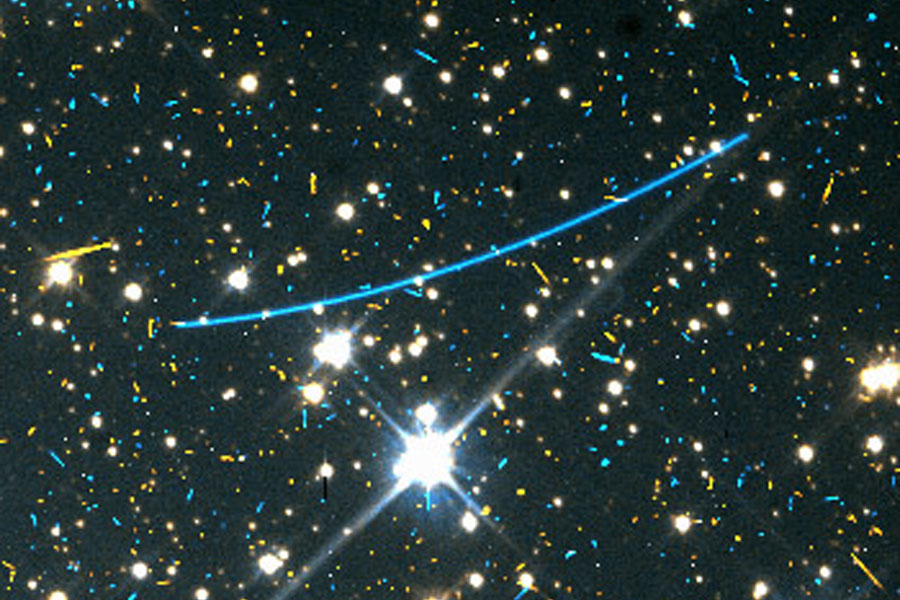
The debris that litters space—meteorites and asteroids—serves as the primary ledger for the early solar system. Recent isotopic analysis of ungrouped iron meteorites confirms a fundamental divide between carbonaceous and non-carbonaceous bodies, revealing that these parent bodies accreted distinct nebular components. While some meteorites show evidence of impact-induced melting, others remain fragile, preserving the chemical signatures of their formation. These rocks, whether found in the Antarctic ice or tracked by telescopes, are the remnants of a formative era when the solar system was a crowded, collision-prone workshop.
These rocks are the remnants of a formative era when the solar system was a crowded, collision-prone workshop.
The Dust Problem
Even the act of exploration introduces its own complications. As NASA’s Artemis program looks toward the lunar surface, the problem of plume-surface interaction remains a significant hurdle. The simple act of landing a spacecraft kicks up regolith, creating a cloud of high-speed particles that can damage hardware and obscure vision. This challenge, first noted during the Apollo missions, underscores the reality that our presence on other worlds is inherently disruptive. Understanding how rocket exhaust erodes the surface is not just an engineering requirement; it is a necessary acknowledgment of the friction between human ambition and the alien environments we seek to inhabit.